
Stating the obvious: since the end of the 2016 season the Detroit Tigers haven’t been all that fun to watch.
At the end of the 2016 regular season, General Manager Al Avila did the right thing and announced that the Tigers would be stripping down their current roster and beginning a full-scale rebuild of the organization from the ground up. This means lackluster baseball and a lot of losses at the Major League level, but there are some interesting pieces starting to take their place in the minor leagues. They have quickly restocked their bottom shelves, so to speak, and have gone from a bottom-five farm system to, arguably, one that belongs in the top-ten discussion.
Does this mean that the Tigers are knocking on the door of being a competitive team again soon? Not a chance. But what it does mean is that there are prospects in their minor league system that could contribute to a team that will eventually compete, and a few could be key players on that team. A few to keep an eye on, while dreaming for better days for the Tigers:
1. Casey Mize, RHP
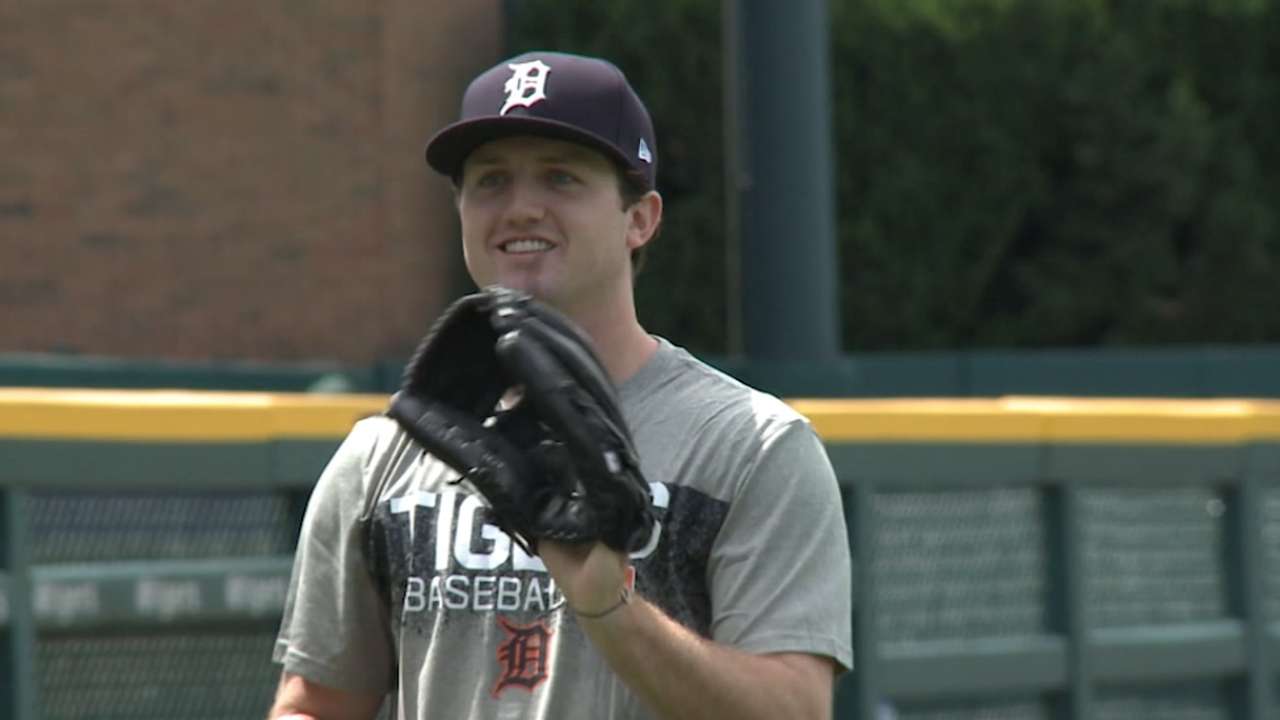
No question, Casey Mize belongs at the top of this list. He was the #1 overall pick in last year’s MLB draft, and quickly showed why in his brief stint of professional baseball in 2018. Don’t let his ERA in 13.2 innings fool you: he struck out 14 minor leaguers, had a strikeout percentage of nearly 40%, and only walked three hitters out of the fifty-five that he faced across Rookie ball and Class-A Advanced last year.
MLB Pipeline listed his splitter as the best “other pitch” out of every pitcher in the minors which I already regard as a “plus-plus” pitch, and his fastball and changeup are already regarded as “plus” pitches compared to his counterparts in the Majors. He could arguably compete in the Major Leagues right now, but the Tigers will do the sensible thing and let him get his feet wet in the minors for at least the entirety of 2019 (possibly starting where his 2018 ended in A+ Lakeland), and at least a portion of 2020, too.
Mize has an extremely high ceiling as possibly one of the very best pitchers in the game, period, but he also has an extremely high floor, too. Even if he fails to polish his slider and his command, he still likely settles in to any rotation as a middle-of-the-pack starter. He’s certainly someone worth the $7.5 million signing bonus, but my assessment of him also means he merits the time necessary in the minor leagues to obtain the polish necessary to become Detroit’s ace. No need to rush him to the Majors, and for everyone’s sake, I hope they don’t.
2. Matt Manning, RHP
Matt Manning is the only other top-ten draft pick the Tigers have had in the last ten years, drafted 9th overall in 2016. Matt, was drafted out of high school with very very little actual baseball experience. As the son of former NBA player Rich Manning, Matt started out on the basketball court and only started pitching in high school. Scouts quickly recognized his raw strength and athleticism and pegged him to be a risky, albeit intriguing, early 1st rounder in 2016.
I will admit to you, I absolutely hated this draft pick at the time, but saw the merits of selecting him. Manning has extremely raw talent and a low mileage on his arm. Where most high school pitching prospects are already starting to undergo wear and tear in their latter high school years, Manning was just starting to loosen up and air out his fastball. Getting professional instruction while his arm is still fresh gave him a huge advantage over the incoming draft class in both possible longevity and coachability, and he hasn’t really disappointed to this point.
Manning has had some impressive numbers: he struck out 154 in 117 innings in 2018 across three levels of the minor leagues, reaching Double-A Erie, and he even improved in his control: just 43 walks and a WHIP of 1.198. However, there are three major aspects of his development that he will need to come to terms with before ever touching the Majors: his command, the polish on his secondary pitches, and his ability to repeat his delivery. I had a chance to watch Manning during his stints in West Michigan with the Whitecaps, and I can tell you he had issues in repeating his delivery which accounted for some wonky results: I have seen his fastball touch 96 MPH, I have also seen his fastball barely touch 87 MPH in as early as the third inning. He did not appear to be gassed, but his mechanics did appear to be out of whack.
His issues stem from one thing: his rawness as a baseball player. The kid is 6’6″ and is an imposing threat on the mound. His floor is likely as a low-leverage middle reliever, but his ceiling is a number 2 starter. There is a lot of middle ground there that Manning will likely settle into, somewhere between his floor and his ceiling, but his overall numbers in the minors suggest he’ll probably make it to the Majors, someday, as a starting pitcher. He will start 2019 in Double-A, my hope is he stays there all year and puts up gaudy numbers.
3. Beau Burrows, RHP
Beau is another first-round pick of the Tigers (22nd overall in 2015). He has had a slow development: he spent all of 2016 in Single-A West Michigan, split his time in 2017 between Class-A Advanced Lakeland and Double-A Erie, and spent all of 2018 in Double-A. He will likely spend most, if not all, of 2019 at Triple-A Toledo.
Burrows is not an overly dominant pitcher, at least not compared to Mize and Manning. He’s not really an imposing physical threat, and doesn’t really have much that screams “above average pitcher” at you. He has an above-average fastball that can touch the high-90’s on occasion, but he relies on it heavily to get hitters out. He lacks consistency with his 12-6 curve and changeup that will not translate to Major League success. However, he’s still incredibly young, and has put up anywhere from passable-to-good numbers at every level of the minor leagues he has reached.
He really needs to be able to consistently locate and command his changeup. That’s the difference between him being a number 3 and a number 5 starter. Expect him to be one of the first call ups mid-year if a Tigers starter goes down in Detroit. I have a feeling he might see some time in the Motor City in 2019.
4. Alex Faedo, RHP
Another right-handed starting pitcher, huh, Thomas? Don’t worry, I still have one more, and he cracks the top-5. Honestly, the Tigers’ only claim to a good farm system is their right-handed starting pitchers. Without them, they’re still lingering at the bottom of the farm system rankings.
Alex Faedo is, once again, a first-round pick of the Tigers (18th overall in 2017). Unlike the three pitchers listed above, I would argue that Faedo has actually struggled since he entered the league this year. Granted, this year was his first playing professional baseball, and the Tigers did him no favors by inserting him into some of the tougher echelons of the minor leagues that you can start a player, but I am still going to toss a little bit of criticism Faedo’s way.
Faedo’s calling card his is secondary stuff: he has an absolutely nasty slider that is probably the best in the Tigers’ minor league system. His changeup shows flashes of greatness, too, when I analyze his video. I would rate it as average now, which the potential to be a plus pitch. Where he struggled last year was his fastball, and velocity was a problem for him: at the University of Florida, his fastball sat in the mid-90’s consistently, in 2018 between Lakeland and Erie, he was regularly in the low-90’s. With a slider that touches 87 MPH, that’s not much of a speed differential between the two pitches, making it harder to keep professional hitters off balance, and it showed this year. He was unable to miss bats: only striking out a little over 20% of the batters he faced this past year. That is something that he needs to iron out in 2019.
As it stands right now, without any additional zip on his fastball, Faedo is a bottom-of-the-rotation starter, at best. There will not be a place for him in a future Tigers’ rotation if he cannot hone his fastball and add it back to his arsenal as at least an average pitch.
5. Franklin Perez, RHP
Perez was the crown jewel of the 2017 Justin Verlander trade with the Houston Astros. Without Perez included in the deal, the trade would have never gotten done. The Tigers got a sizable haul from the Verlander trade (the other two pieces will be mentioned later in the “5 position player prospects to watch” post), and if Perez pitched a full season in 2018, he could have very well been number 2 or number 1 on this list, but he missed almost all of 2018 with nagging injuries that kept him off the mound most of the season.
Perez lacks the same kind of upside that Mize and Manning bring to the table, but has the same capability of missing bats that they do. All of his pitches grade out to at least average at the moment, along with his command. All he needs to do is stay healthy and stay the course in 2019. Lingering health issues aside, every attribute he possesses as a pitcher has the potential to grade out as above average, making his floor a serviceable MLB starter, and his ceiling a #2-3 starter in a rotation.
Where are the hitters?
If I was doing a top-10, top-25, top-50, top-whatever prospect ranking’s post, none of the Tigers current position players in my mind warrant top-5 status. Not right now. The biggest detriment to the Tigers’ farm system right now is the lack of a truly talented, high-upside position player in their minor leagues. Like it or not, they just don’t have anyone that sparks enough intrigue to warrant a top-5 selection. In all honesty, the only Tigers’ farmhand that has really shown any legitimate potential at all in the last ten years was Nicholas Castellanos. Just Nick. That’s it.
High on the Tigers’ to-do list for 2019 is to invigorate their farm system with high-upside position players, most notably with the number 5 overall pick in this year’s draft. I’m sure they hope to infuse more position player potential with a Castellanos trade, as well, but I worry that they are not going to be able to find anyone with that truly intriguing upside, because even with Castellanos’ offensive ability, he’s a huge defensive liability that makes him less of a commodity to interested teams than someone who is a more complete player.
In other words, the Tigers are going to have to build that pipeline themselves through solid drafting and smart international signings, which is why they are not going to be competitive any time soon.
But I digress, their pitchers are incredibly interesting, and I encourage everyone to pay attention to them in 2019.
:format(webp)/cdn.vox-cdn.com/uploads/chorus_image/image/56817025/851752428.0.jpg)
/cdn.vox-cdn.com/uploads/chorus_image/image/48028301/GettyImages-481156224.0.jpg)


