MLB Expansion: What Does It Look Like? Part 1 (of 3): Identifying the Cities

Four weeks ago, I evaluated the current state of Major League Baseball, and mentioned that one of the ways to curb a non-competitive environment in the game would be to expand the postseason. The most feasible way to do that involves MLB expanding: adding two teams to bring their total to 32 teams.

Expansion to 32 allows for all sorts of intriguing possibilities: shortening the regular season (we’ll revisit this in part 2), expanding the postseason, and, most importantly, dividing the divisions up into more geographically convenient entities (improving travel) and decreasing the number of teams in each division from 5 to 4. Three divisions of five teams in each league is an odd way to divide the league. It’s antiquated, it’s confusing, and it allows nearly two thirds of the league to get away with tanking. Four divisions with four teams each makes the playing field far more competitive.

To do this, the National League also has to implement the DH, getting rid of the pitcher taking a place in the lineup. I understand traditionalists’ desire to keep the tradition of pitcher’s hitting in the lineup, but adding the DH makes economic sense for two big reasons: 1.) It creates jobs for 15 (or for the sake of expansion 16) additional DH’s, prolonging the careers of some of our favorite players, and 2.) fans appreciate offense. I understand the enjoyment of a pitcher coming through with a big hit, but those moments are few and far between. Even the worst hitters in the game today can outperform a pitcher over 600 plate appearances.

For the sake of this piece, I am moving forward with two assumptions: 1.) that the Oakland Athletics resolve their stadium issues with their proposed new stadium, and 2.) the Tampa Bay Rays, who’s stadium issues have hit a snag, are relocated. In this case, I am going to take one of the potential cities for expansion off the table and put them in Charlotte, North Carolina, making them (for now) the Charlotte Rays.
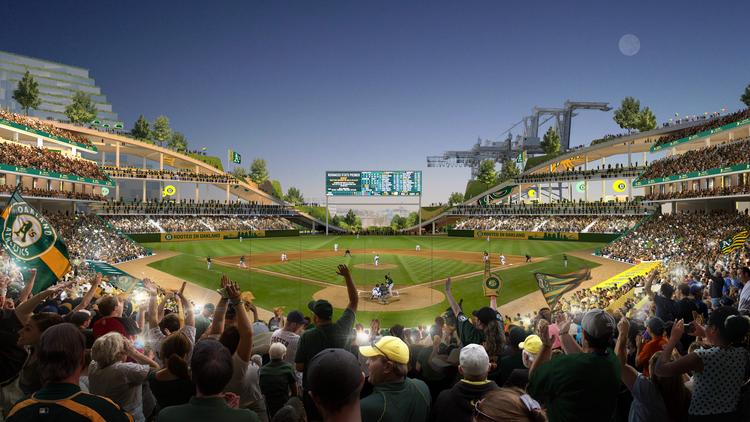
A rendering of the new ballpark to be built in Oakland, California.

Why Charlotte?

Let me start with the obvious: relocating the Rays to Charlotte eliminates the potential problem of having to realign the divisions in a 30-team scenario. It still puts the Rays in the American League East, and in fact, makes them geographically closer to their AL East counterparts in the Baltimore Orioles, New York Yankees, Boston Red Sox, and the Toronto Blue Jays.

The view from Charlotte’s current minor league ballpark.

In addition, there are other reasons that make Charlotte the prime destination for a relocated team: 1.) they have led the minor leagues in overall attendance two of the last three years. 2.) they already have a wildly successful major league franchise based in Charlotte in the National Football League’s Carolina Panthers, and they have a National Basketball Association presence in the Charlotte Hornets. 3.) It has the 23rd largest media market in the country, ahead of six current MLB teams. Finally, 4.) North Carolina is a state already deeply engrained in baseball culture with Team USA’s headquarters in Durham, NC, strong collegiate programs in UNC and NC State, and a myriad of minor league franchises peppered throughout the state. MLB in Charlotte just makes sense.

Where to Next?

All told, there are several other destinations to house two more MLB teams. By media market size throughout North America, they are as follows:

  1. Mexico City, Mexico
  2. Montreal, QC
  3. Tampa-St. Petersburg, FL*
  4. Orlando, FL*
  5. Calgary, AB
  6. Raleigh-Durham, NC*
  7. Sacramento, CA*
  8. Portland, OR
  9. Vancouver, BC
  10. San Juan, PR
  11. Nashville, TN
  12. Indianapolis, IN
  13. Salt Lake City, UT
  14. San Antonio, TX*
  15. Hartford-New Haven, CT*
  16. Columbus, OH*
  17. West Palm Beach, FL*
  18. Greenville, SC
  19. Las Vegas, NV
  20. Austin, TX*

Already, quite a list. I haven’t even gotten to Jacksonville, FL, New Orleans, LA, Green Bay, WI, or Memphis, TN. All cities that house at least one major league sport franchise.

Notice a lot of asterisks? Well, the reason that they’re there is pretty simple, but I’ll get into that more in a second by first explaining the situation with Tampa. Tampa just lost their team, and acting in good faith as the de facto MLB Commissioner I am assuming that they will not be in consideration for expansion. If they did not want to ante up the taxpayer dollars for a new stadium for the Rays, then no right-minded investor is going to want to go near that market to put up an exorbitant expansion fee upwards of $1 billion, in addition to building a privately-funded brand new stadium in the Tampa Bay area. It isn’t going to happen anymore.

The rest of the media markets on this list are in what is considered “anti-trust” territory. Back in the 20’s, the United States Supreme Court set a legal precedent for MLB, making them one of the few entities in the entire country with an antitrust exemption. To spare you the legal jargon: they are legally a monopoly that can flex their muscle on any region they have already laid a claim for both their Major League and Minor League affiliates. The asterisked markets represent a direct competition with a Major League market. Orlando, FL would absolutely be in the Miami Marlins’ territory, Raleigh-Durham would interfere with what Charlotte is trying to do, Sacramento would have to pry themselves loose of San Francisco and Oakland’s grasp, and San Antonio, Hartford, Columbus, West Palm Beach, and Austin would all have the likes of the Astros/Rangers, Yankees, Indians/Reds, Marlins, and Astros/Rangers to deal with, respectively. Too many hoops to jump through, so let’s call them a wash.

Mexico City, Montreal, Calgary, Portland, Vancouver, San Juan, Nashville, Indianapolis, Salt Lake City, Greenville, and Las Vegas remain.

Eliminating The Rest

Let’s get a few of these cities out of the way so we can pave our way toward expansion.

Mexico City is a huge market, but if we’re being honest, there are too many issues with the market to call it a safe bet. It is consistently hotter there than any US city, excluding Phoenix, AZ and Las Vegas, NV, so a retractable-roof, AC powered stadium would be necessary in that market. Plus, it is at an extremely high elevation, which means the air is less dense and the baseball will travel more freely there. It would be a hitter’s paradise. Neither of these are the main issue to eliminate Mexico as an expansion team. Travel issues would be sure to be the hurdle that eliminates Mexico from the list. Additionally, soccer is Mexico’s behemoth sport, and baseball would need to be a sure thing to turn a profit, and I don’t think there’s enough evidence there to suggest baseball would be immensely successful there. Take Mexico City off the list.

Montreal has had a MLB team in the past: the Montreal Expos. However, they were always a small-market team that struggled to draw a crowd, and their old stadium is in desperate need of renovation or replacement. There is evidence to suggest that baseball could make a comeback in Quebec (an enthusiastic mayor and sellout exhibition games make me wonder), but it doesn’t make my final cut.

Calgary has a large enough media market, and the CFL has probably their most successful team housed in Calgary in the Stampeders, but baseball in an unestablished market is forcing me to eliminate them from contention. Vancouver is in the same boat, coupled with the fact that it’s too close to the Seattle Mariners for comfort, I imagine.

San Juan is still recovering from Hurricane Maria. Baseball is a part of the lifeblood of the US territory, but without statehood, I don’t think it has the funds or the development to successfully house a MLB franchise. Scratch San Juan from contention. Grant them statehood and give them the funds to develop as any US state would, and I think we can have a different conversation.

Indianapolis would be interesting, it has a strong MiLB following (it led all of minor league baseball in attendance in 2017 and regularly fronts strong attendance numbers). However, another team in the Midwest is not what baseball needs. Their media market only consists of the metro area. Go too far south, and you have crossover with the St. Louis Cardinals or the Cincinnati Reds. Go too far north, and you’re encroaching on the rich history of Chicago White Sox and Chicago Cubs fans who are not going to be shifting their allegiance anytime soon. Count them out.

Salt Lake City and Greenville are not large enough markets and are not growing enough to lead me to believe they are viable candidates for expansion.

Ah, Las Vegas. They are already seeing the success story of their expansion team in the National Hockey League in the Vegas Golden Knights (Western Conference Champions in 2017-2018) and will be welcoming the Las Vegas Raiders to the NFL in 2020. But those two sites were already being funded by taxpayer dollars, a retractable-roof, AC powered ballpark would cost their taxpayers an additional $1 billion. I don’t think you will be able to sell Las Vegas proper on this one. Even if you could, I think baseball dies in that desert as the Raiders and the Golden Knights will already be trying to establish their markets and consumer base. Another team muddies the landscape and residents and tourists alike will be torn as to where to go and who to follow. It’s too new of a market to try and expand to.

That leaves Portland, OR, and Nashville, TN, as our two sites for expansion.

Why Portland? Why Nashville?

Let’s start with Portland, they’re the easiest to establish. Portland has been trying to acquire a MLB team for a very very long time. They have been the source of several threats for relocation, and just a few weeks ago they unveiled a plan and a site to build a MLB-ready ballpark in their city. Portland is also loaded with investors ready to jump at the chance of owning a MLB franchise. With no more threats of relocation as the Rays have been moved to Charlotte, MLB has no choice but to grant Portland a bid for expansion. Welcome to the MLB, Portland Beavers.

A rendering of the proposed ballpark to be built in Portland, Oregon.

Nashville is one of the fastest growing cities in the United States. They already have two successful franchises in the Tennessee Titans of the NFL and the Nashville Predators of the NHL, and with MLB teams in just Charlotte and Atlanta, MLB doesn’t really have a stronghold on the south. Nashville already houses a successful collegiate team with a strong following at Vanderbilt, the city itself is a tourist attraction, and the closest competing market is the Atlanta Braves. With investors lined up and ready to pull the trigger on a site adjacent to the Titan’s Nissan Stadium, this one is another no-brainer. Nashville Mountaineers, welcome to the show.

How Does This Set Up Realignment?

This allows for better realignment within the league, geographically, to make travel less of a nightmare. Let’s first start out by laying out our current 30 team league as it stands now:

AL East:

  1. Boston Red Sox
  2. New York Yankees
  3. Toronto Blue Jays
  4. Baltimore Orioles
  5. Tampa Bay Rays

NL East:

  1. New York Mets
  2. Philadelphia Phillies
  3. Washinton Nationals
  4. Atlanta Braves
  5. Miami Marlins

AL Central:

  1. Cleveland Indians
  2. Detroit Tigers
  3. Chicago White Sox
  4. Minnesota Twins
  5. Kansas City Royals

NL Central:

  1. Pittsburgh Pirates
  2. Cincinnati Reds
  3. Chicago Cubs
  4. Milwaukee Brewers
  5. St. Louis Cardinals

AL West:

  1. Houston Astros
  2. Texas Rangers
  3. Los Angeles Angels
  4. Oakland Athletics
  5. Seattle Mariners

NL West:

  1. Colorado Rockies
  2. Arizona Diamondbacks
  3. San Diego Padres
  4. Los Angeles Dodgers
  5. San Francisco Giants

As you can see, there are travel issues littered in this layout. The Seattle Mariners have to travel 2,300 miles to play their division rivals in Houston. The Mets have to travel 1,300 miles to play their division rivals in Miami. This doesn’t make any sense. Add to the fact that only 33.3% of these teams make the playoffs, and it goes from not making any sense to a damn shame.

Throw two more teams into the mix, and things get much easier. I eliminated the AL/NL and am now just calling the divisions for what they are, geographically:

Northeast:

  1. Boston Red Sox
  2. New York Yankees
  3. New York Mets
  4. Philadelphia Phillies

Appalachian:

  1. Baltimore Orioles
  2. Washington Nationals
  3. Pittsburgh Pirates
  4. Cincinnati Reds

Great Lakes:

  1. Toronto Blue Jays
  2. Cleveland Indians
  3. Detroit Tigers
  4. Milwaukee Brewers

Midwest:

  1. Chicago Cubs
  2. Chicago White Sox
  3. Minnesota Twins
  4. St. Louis Cardinals

South:

  1. Charlotte Rays
  2. Nashville Mountaineers
  3. Atlanta Braves
  4. Miami Marlins

Central:

  1. Texas Rangers
  2. Houston Astros
  3. Colorado Rockies
  4. Kansas City Royals

Southwest:

  1. Arizona Diamondbacks
  2. San Diego Padres
  3. Los Angeles Dodgers
  4. Los Angeles Angels

Northwest:

  1. San Francisco Giants
  2. Oakland Athletics
  3. Portland Beavers
  4. Seattle Mariners

No, it’s not perfect, but it still works on a logistical level. It also creates some new rivalries (Oakland/San Francisco, Detroit/Toronto, LA/LA, NY/NY, Portland/Seattle, Yankees/Phillies, and Chicago/Chicago all come to mind). Eight division winners, four wild card participants, and 50% of MLB receives an invitation to the postseason? I can get behind that.

 Part 2 will focus on shortening the regular season schedule, part 3 will reveal how MLB has implemented expansion in the past, and what that means for teams that you care about. Coming soon.

The Game Is Broken: How Do We Fix It? Part 1: Mediocrity

Be honest with me here: when was the last time you have been genuinely excited about baseball?

Most of my friends and family adore the Detroit Tigers. It is an undeniable fact. The last time the Tigers played any meaningful baseball was in 2016 as they faded from playoff contention during the regular season’s final moments. The last time they played exciting baseball was two years earlier as they marched to their fourth consecutive American League Central title. They were promptly handed three straight losses in the Division Series to an arguably inferior Baltimore Orioles, and the rest is history: they have been anywhere from mediocre to abysmal ever since.

Watching teams that suck is no fun. That’s obvious. But even organizations that have put together talented rosters have made the game a chore to watch.

It is no big secret that after working for the Milwaukee Brewers, I have become an avid fan. This year, by win-loss record alone, they were the best team in the entirety of the National League. I watched every single postseason game, and even I found myself having a difficult time staying focused:

The constant pitching changes, pinch hitters, double switches, defensive substitutions! The gameplay stoppages were a regularity. There were a fair share of shorter games this postseason, and the overall length of an average game is shortening, but there were several that crept beyond 4 hours in length.

The pace of play is an issue, no question, but the biggest culprit of the lack of excitement stems from my first point: watching teams that suck is no fun.

MLB’s revenue has never been higher. It eclipsed $10 billion in revenue in 2017 and has increased every single year for the last 16 years. However, MLB’s attendance rate is declining. It dropped 4% in 2018, and it dropped in 2017, too. MLB’s theory publicly is that inclement weather in March and April sabotaged any chance of an attendance increase this year. My theory is much more honest:

No one wants to pay to watch a mediocre product.

Tanking

Tanking has gained prevalence in professional sports lately. From the NBA’s Philadelphia 76’ers “Trust the Process”, to the 2015-2017 World Series Champions: the Kansas City Royals, Chicago Cubs, and Houston Astros. Each one of these teams rose to prominence by completely gutting their rosters, enduring grueling seasons with hardly serviceable players and hundreds of losses between them, all to obtain top draft picks to build a championship team from the ground up. These teams saw an opportunity to take advantage of revenue sharing in their years of futility and use that as fuel to fund their ailing rosters. After many, many, many years of rebuilding, they got theirs: a World Series Championship.

In theory, this is a solid baseball strategy. The teams reap the benefits of the successes of others to stay financially profitable as fans stay home, and they come out in droves when the product is appealing again. The problem, and stark reality, is this: more MLB teams are doing this than ever before.

The age of analytics allows all teams to have access to the same information, and teams are starting to evaluate wins the same way. Their roster building strategies are becoming more black-and-white: a collection of cheap, controllable players who have exclusive negotiating rights with their team for multiple seasons is far more valuable to them than one superstar free agent on a $300 million contract (looking at you guys, Bryce Harper and Manny Machado). The way MLB teams conduct business is changing, and no team is a better example of this than the New York Yankees.

The New York Yankees: A Brief Case Study

The Yankees used to be big spenders in the free agent market. It’s not a secret, it’s public record. The Yankees used to spend hundreds of millions of dollars on free agent players like Alex Rodriguez ($275 million in 2008), C.C. Sabathia ($161 million in 2009), and Mark Teixeira ($180 million in 2009). From 1999-2013, the Yankees opened the season with the highest payroll in baseball. Then, in the 2016 offseason, something very interesting happened:

The Yankees’ payroll dropped, significantly. When the Yankees opened their season in 2016, their payroll eclipsed $213 million, in 2017, it was $168 million. Their payroll was virtually identical in 2018, but they dropped five spots in overall spending, from second most in the league to seventh.

What changed in their overall philosophy? Behind the scenes, they were undergoing a massive overhaul of their minor league pipeline of talent. Stars like Aaron Judge, Gleyber Torres, Gary Sanchez, Luis Severino, and Miguel Andujar were called up to the Big Leagues, as expensive stars like Alex Rodriguez, Mark Teixeira, Mariano Rivera, and Derek Jeter made their exits. The team is still saddled with expensive contracts like Giancarlo Stanton’s or Jacoby Ellsbury’s, but they are not making major long-term offers to star players any more. In fact, no one really is.

Free Agency Dormancy

Free agent spending is decreasing, and the lengths of contracts being signed by free agents are getting shorter. In the 2017-2018 offseason, there were 203 professional free agents in MLB. Of those, five free agents signed a contract for longer than three years. Five. The 2018-2019 offseason has not ended yet, but the numbers are even more jarring: as of this post, the number of free agents who have signed a contract longer than three years is a measly three. When it’s all said and done, there will assuredly be more (looking at you guys, Bryce Harper and Manny Machado), but we are less than a month away from pitchers and catchers reporting for Spring Training, and most of the league’s most talented free agents are still sitting at home and working out without a contract. That’s extremely problematic.

So, the big question is why? Why aren’t teams spending money to help them win a championship? The answer is simple: it is a better baseball strategy, and a better economic strategy, to build your roster through tanking and rebuilding.

The Tangible Impact of Tanking Through the Eyes of a Front Office vs. The Fans

Here’s the bitter reality of baseball today: if your team is not a sure fire bet to make it to the postseason, then you have to do something to set your team up for long-term success. Through the eyes of a fan, it is fairly easy to see a marked performance difference between an 85 win team that did not make the postseason and a 50 win team that did not make the postseason. When I think about it in the context of a front office building a roster, I just see a team that did not make the postseason. Teams have no long-term benefit trading cheap and controllable potential big leaguers for established rental players eligible for free agency in the short-term if it does not net them a postseason appearance, plain and simple.

During the season, July 31st and August 31st are big days in determining the landscape of baseball: it’s MLB’s non-waiver and waiver trading deadlines, respectively. I could explain the nuances of each to you, if you wish, but the important takeaway from those two dates is that they are the last opportunity a team has to acquire the rights to a player already contracted to another team. The lead up to these dates establish “buyers” and “sellers.” If your team is pushing for a postseason berth, they are likely to be buying established MLB talent. If they are not, they are selling off their established MLB talent in exchange for players, cash considerations, and some unrestricted draft picks in the following year’s amateur player draft.

More than ever, teams are reluctant to “go for it”, and it has become a seller’s market. Teams that are buying are finding that the asking price for players on other teams are exorbitantly high, and sellers are finding the competition crowded because every other team out of contention is trying to do the exact same thing they are. Teams value minor league talent and cost-controlled players higher than ever before, and it is leading to a diminished product as collateral damage. Every team that is out of contention is trying to become the next Kansas City, Chicago, or Houston, and that extends to the buyers as well.

The buyers: the Boston Red Sox, Houston Astros, and New York Yankees each walked away from 2018 with over 100 regular season victories. Eight other teams finished with 90+ wins. Of those eleven teams, one of them didn’t make the postseason: the Tampa Bay Rays. What’s the difference between the 90-win Tampa Bay Rays and the 115-loss Baltimore Orioles? A lot, but they share one thing in common: neither played in October.

Meanwhile, 14 teams finished with losing records. Nearly half of baseball. Fourteen teams tried to sell their players to eleven buyers, creating a slew of trade rumors, much of it with little to no traction. Though some will not openly admit it, the overall strategy was to better their draft positioning for next year, where they can dip into the amateur player pool to spend a fraction of the money they would spend on free agents on players they control for six years or more.

How Does This Change?

I think the way the business is structured is a big reason why this mediocrity problem exists, and it starts with expanding postseason play. Major League Baseball has the smallest potential window of postseason opportunity than any major sport in North America: only 33.3% of their teams are eligible to play in the postseason. Compare that to the NBA, where 53.3% of their teams are eligible. Even the NFL, the second most exclusive postseason market, grants 37.5% of their teams the opportunity to compete for the Super Bowl.

There are only two realistic scenarios: the inclusion of one more wild card team in each league, or two wild card teams in each league. The inclusion of one additional wild card team opens up an NFL-style postseason bracket: the two best division winners in each league receive a first round postseason bye, and the other four participants either play a one-game playoff or a three-game series (I personally prefer three-game series, give every postseason participant the opportunity for at least one home playoff game). The rest of the postseason can be played as it usually does: a five-game Division Series round, and a seven-game Championship Series and World Series.

The second scenario is a lot easier to envision if two things happen: one, MLB expansion brings in two more teams, bringing the league to 32 teams, and two, the regular season is shortened to 154 games (I will get into this in a lot more detail in a future post). Shortening the regular season with a 32-team league has been well researched and I suggest Googling some of the benefits of what a shortened season could do for scheduling purposes, but the greatest opportunity to come of a shortened season is an expanded postseason that does not lag into November. Sixteen MLB teams, or half the league, would have a legitimate shot at a World Series title in an NBA Finals or NHL Stanley Cup Playoff-like bracket with the 1-seed pitted against the 8-seed in the opening round, the 2-seed against the 7-seed, and so on. Teams would be less apt to race to the bottom, and teams would be more willing to trade and sign players to chase a World Series title. Even teams on the fringes of contention would have a legitimate shot of getting into the playoffs as the 8-seed and knocking out the 1-seed en route to a Cinderella story World Championship. The Los Angeles Kings won a Stanley Cup that way not that long ago, and though an 8-seed has ever won the NBA Finals, an 8-seed has won their conference championship. Baseball can be far more fickle than either sport, 8-seeds are legitimate threats in MLB.

The other option that I think is worth exploring is shortening the free agency clock from six years to four. In Major League Baseball, players must accrue 6 years of MLB service time before they are eligible for free agency, accrued through being on a MLB roster (either active roster or MLB disabled list) for 172 days. Teams constantly work around this guideline by waiting a few weeks into the season before calling up a minor leaguer to the big leagues, effectively giving a player less than 172 days of service time and another year of team control. Giving teams less of an opportunity to hold on to cost controlled players and giving players more bargaining power opens up the free market and forces teams to spend on the players they want to keep or go after. Personally, I think this cannot be implemented without a hard salary cap or stricter luxury tax stipulations, but it’s another idea to keep the competitive nature of the game strong.

It’s Not a Simple Problem

…and because of this, there is no simple solution. The reality is that the product is mediocre, and more players than ever before are getting the bad end of the bargain because of it. That requires a difficult conversation likely to come in 2021 when the Collective Bargaining Agreement expires, along with some drastic changes. I will visit some of those changes in Part 2, coming soon.

Create your own website, free on WordPress.com.Create your own website.
Start free